
Concierto barroco
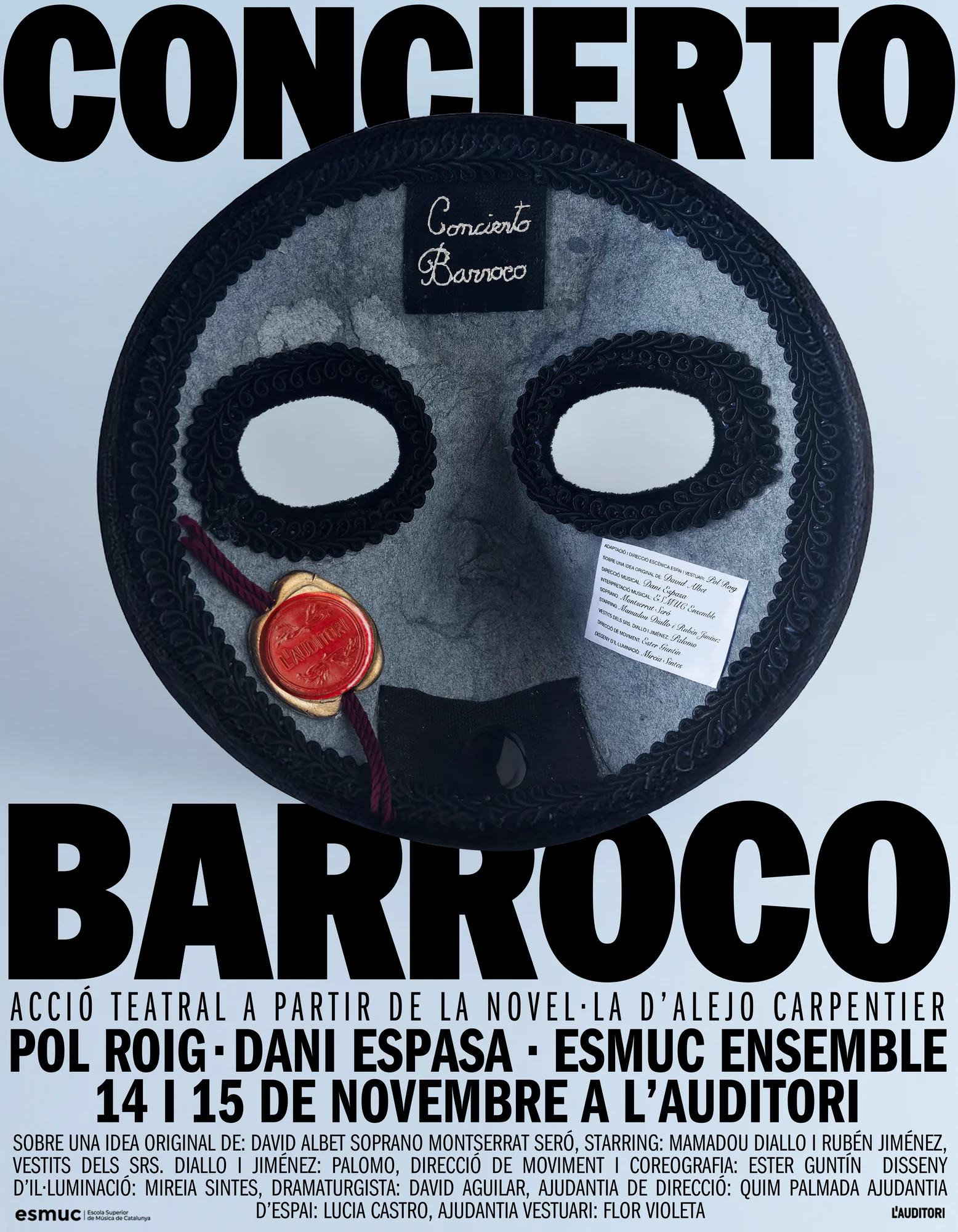
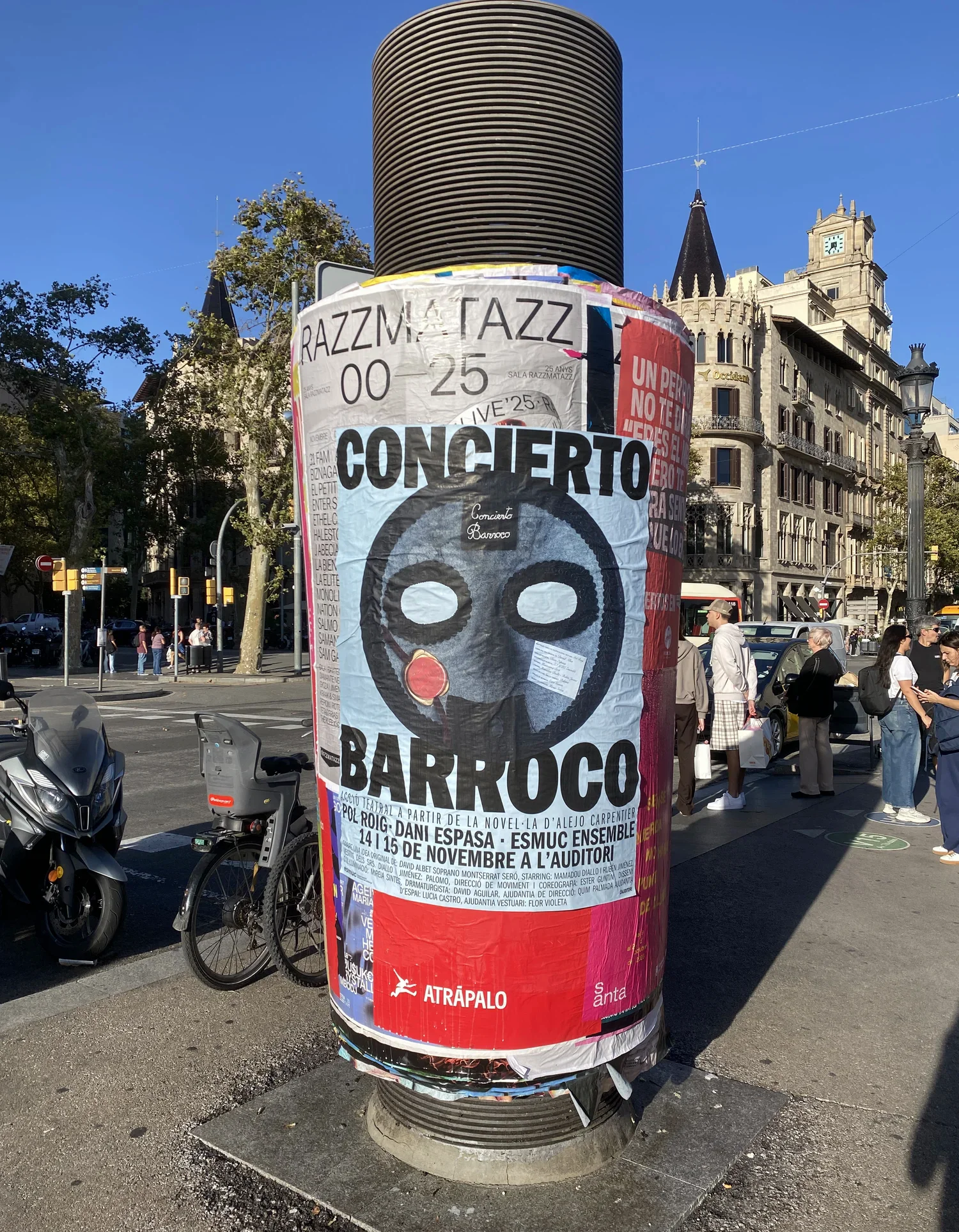
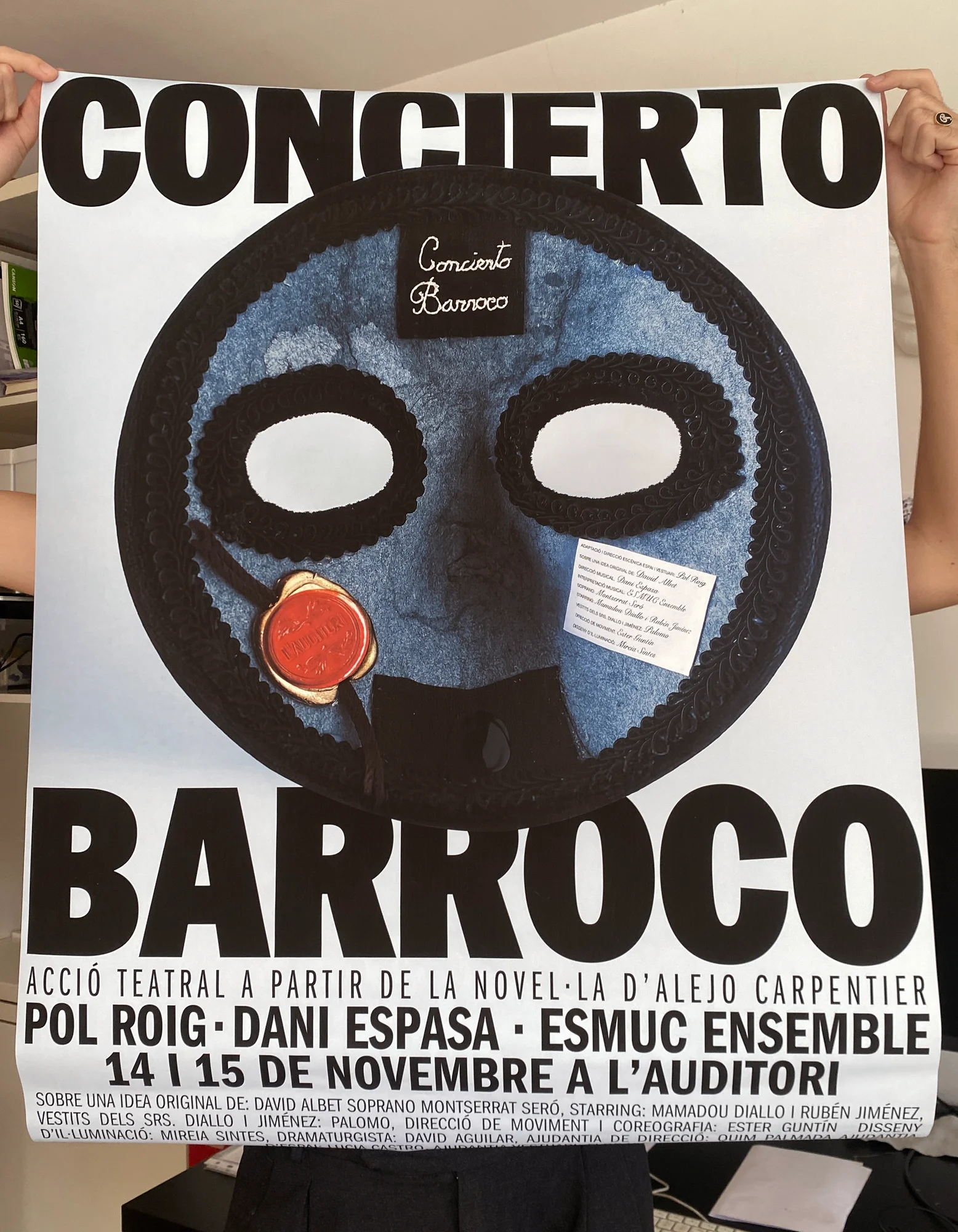
Concierto barroco, Escenes L’Auditori, 2025. Stage direction, dramaturgy and scenography.
(Conductor: Dani Espasa / ESMUC Ensemble)
“The true image of the past speeds away. The past can only be held as a shining image that threatens to vanish with every present that does not recognise itself in it.” Walter Benjamin
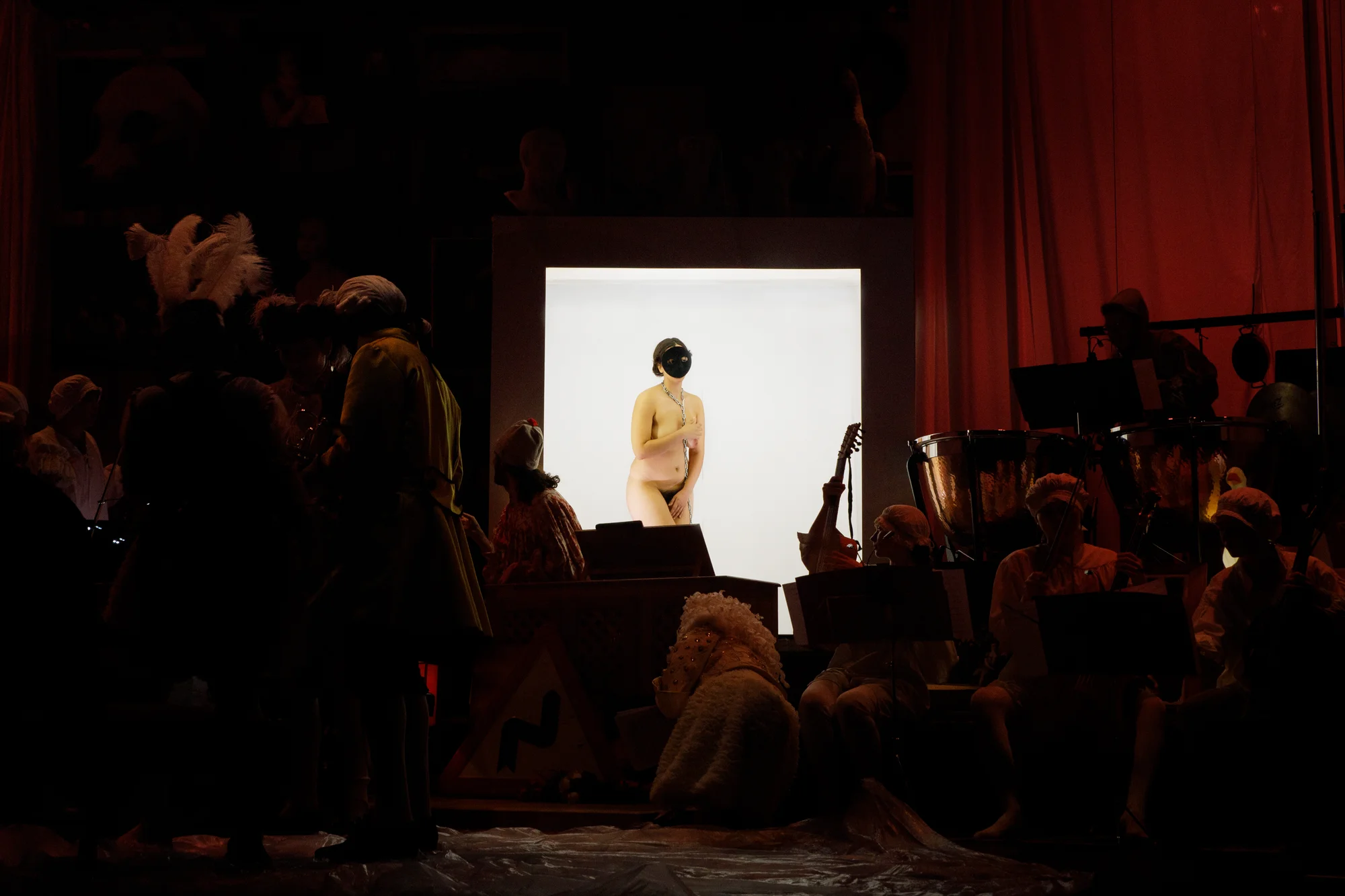
Concierto barroco is a musical and scenic exploration of the novel of the same title, written by Alejo Carpentier in 1974. In a dialogue-free staging, a series of cultural objects serve as a narrative thread, alongside the performance of different musical works drawn from the novel. The musicians themselves, portrayed as the composers and characters who appear in the novel, become the protagonists of an exercise that seeks to reconnect the musical works with their original contexts, dismantling the historical sources behind the fictional device that allows Carpentier to imagine the gaps in the official narrative.
Two panels bearing projected text hang above the stage and function as a supplement, re-signifying and exhaustively cataloguing—with Carpentier’s characteristic irony—everything displayed in this imaginary museum and brought within the viewer’s sight and hearing.
Credits:
Pol Roig, stage direction and dramaturgy
Dani Espasa, musical direction
David Albet, original idea
Montserrat Seró, Anna Girò (soprano)
Mamadou Diallo, Filomeno
Rubén Jiménez Rosco, Indian
Abel Antón, Vivaldi (concertmaster)
Erika Michi, Carmela Sesé, Hernán Cortés, Quim Palmada, extras
ESMUC ensemble:
VIOLINS Irene Sagarzazu / Maria Gil / Nel Cardo / Yiran Niu / Fani Kari / Irimia Menchero · VIOLA Alicia Millán · CELLOS Yeji Seo / Cèlia Juan · DOUBLE BASS Alba Rodríguez · PERCUSSION Lucas Silva · HARP Mateu Bauça · ORGAN Ferran Gallart · THEORBO Inés Wilton · TRUMPET Alejandro Toledo
Alejandro G. Palomo, costume design for the leads
Ester Guntín, movement direction
Mireia Sintes, lighting design
David Aguilar, dramaturg
Judith Solé, special musical composition
Pol Roig, set and costume design
Marto Pérez, technical coordination
Lucia Castro, set design assistant
Flor Violeta Sobrequés, costume assistant
Quim Palmada, assistant director
Amalia S-P de Nieves, wig design and making
Andrea Muratet, costume intern
Andrea Casado, set construction
Victòria Palma, historical advice on the Ospedale della Pietà
Jaume Cortacans, Maria Llena, ESMUC production
Anna Martínez, production manager, L’Auditori
Verònica Rodríguez, head of programming and artistic production, L’Auditori
Irati Urtizberea, musicological advice
Really Sorry Creative Studio, poster image and teaser
Max Villa, poster graphics
Special thanks to Dani Cardevore, Eulàlia Valldosera, Albert Valldosera and Annelies Broeckman.
With the support of Fabra i Coats and the Teatre Nacional de Catalunya.
Teaser directed and produced by Really Sorry Creative Studio (Rafa Castells, Pablito Revival and Geri Guivernau) with Mamadou Diallo. Costumes by Palomo Spain. Barcelona, 2025.
Commentary
by Pol Roig and David Aguilar
Wunderkammern, cabinets of curiosities, were rooms (or sometimes simple pieces of furniture) where the nobility and bourgeoisie of the 16th, 17th and 18th centuries collected and displayed objects of very diverse origins, from works of art to scientific curiosities and exotic objects. Direct ancestors of modern museums, these galleries were characterised by the saturation of space and the eclecticism of the treasures accumulated in them. The wunderkammer is thus a privileged example of the Baroque aesthetic which, as Borges says, plays at exhausting its own possibilities, and it is the basis of the stage device of this piece.
“Vivaldi’s work is a perpetual feast, and I wanted to make a kind of verbal feast.” Alejo Carpentier
Unlike the white box characteristic of the modern museum, the mechanism of the cabinet of curiosities is able to reveal unexpected links, continuities and contrasts between objects, times, spaces and stories. With its abyssal structures, the hypertrophy of its forms and its declared artificiality, the dialogue with the Baroque presents itself as an alternative to the homogenisation and standardisation of present-day categories, guided by the logic of consumption and by an idea of single progress that tends to erase diversity in favour of a clear, refined and singular reading.
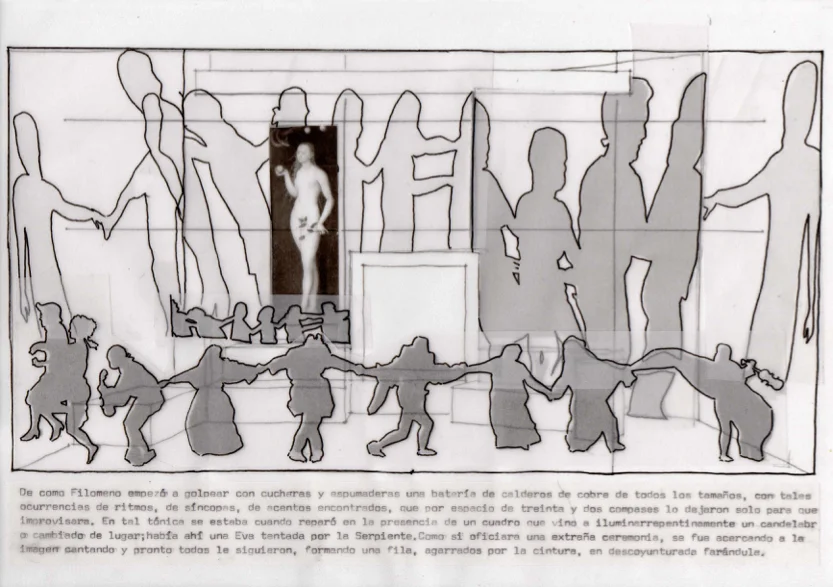
Preliminary sketches by Pol Roig, in ink on tracing paper.
In this way, the Concierto barroco presented here draws on the eclecticism and excess of the wunderkammer to explore the sounds, images and narratives that come from the past—or rather, from which we construct the past, and even more so, the past of others. Because, ultimately, understanding what precedes us means learning to interpret it, that is, to elaborate it, to trace possible readings among all the signs (visual, verbal and sonic) that besiege and saturate us. In this sense, to baroque-ify can be a playful way of claiming the complexity and density of this process, combining original and copy, essence and supplement, history and fiction, in order to detect the grey areas where everything mixes and turns upside down.
“Allegory is a supplement. Conceived as something added to the work, allegory will be separable from it.” Craig Owens
Texts projected during the performance:
Selection and writing of the texts: Pol Roig and David Aguilar.
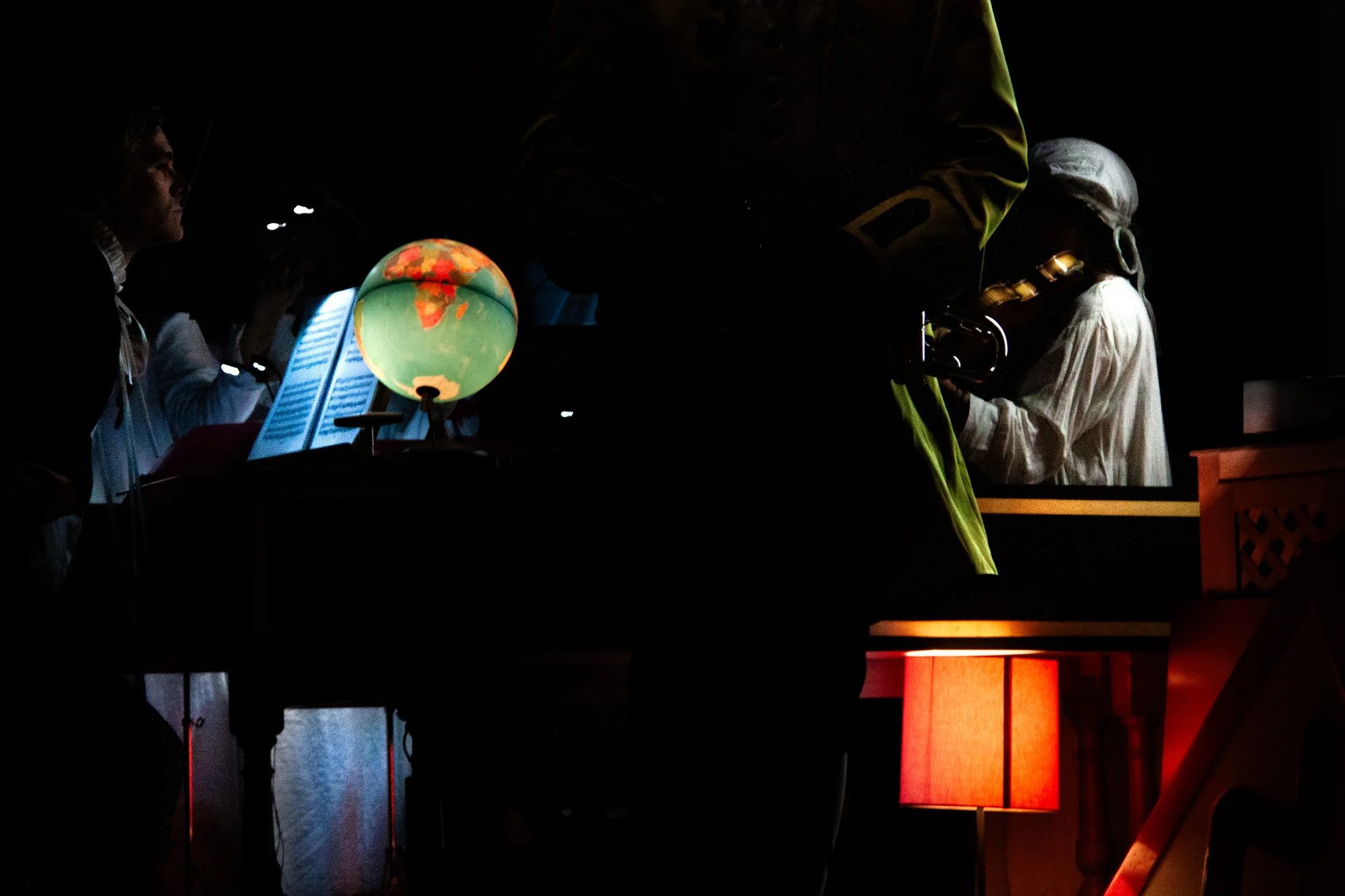
Photographs by Lupe Blanco during rehearsals in Sala 3 at L’Auditori.

